






The Marshall Series Chess Pieces: A Connoisseur’s Guide to an American Classic
The true character of a chess set isn't found in its symmetry; it's revealed in the aggressive, forward-leaning posture of a Knight that seems ready to leap from the board. For the discerning collector, The Marshall Series Chess Pieces represent more than just a functional tool for play. They're a tactile connection to the 1904 Cambridge Springs international tournament, where Frank Marshall's legendary style demanded a set with equal parts brawn and beauty. You've likely felt the frustration of handling poorly weighted imitations that lack the gravitas of a genuine Staunton pattern, or perhaps you've struggled to distinguish between the myriad of modern iterations that strip away the soul of the original design.
In this guide, you'll discover the historical significance and meticulous craftsmanship that define these iconic pieces, from the hand-carved manes of the Knights to the broad, stable bases that offer such a satisfying thud on the board. We'll explore the aesthetic power of this American classic and provide practical advice on selecting the perfect board size to complement its athletic elegance. This journey through the nuances of wood grain and weighting will ensure your next acquisition is a masterpiece of functional art and an investment-grade heirloom for your study.
Key Takeaways
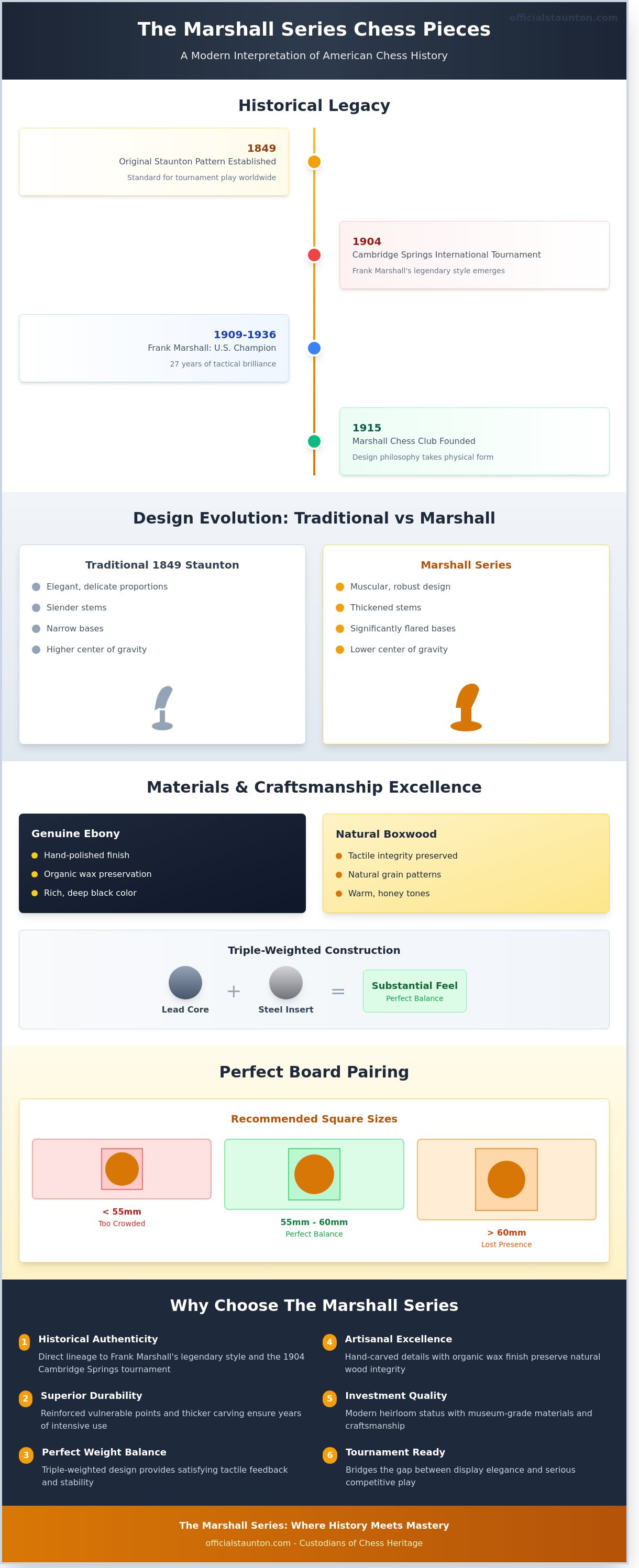
- Trace the evolution of the 1849 Staunton pattern into the more robust, "muscular" interpretation that honours the athletic brilliance of the legendary Frank Marshall.
- Appreciate the artistry behind The Marshall Series Chess Pieces, where genuine Ebony and Natural Boxwood are hand-polished with organic waxes to preserve the wood’s tactile integrity.
- Master the nuances of board selection by identifying why these broader-based designs require a square size of 55mm to 60mm for an uncrowded, professional aesthetic.
- Uncover the technical standards that define a modern heirloom, from the precision of triple-weighting to the historical accuracy maintained by Official Staunton artisans.
The Spirit of the Game: Defining the Marshall Series Chess Pieces
The search for the perfect chess set often leads enthusiasts toward a crossroads where historical accuracy meets modern resilience. For many, the standard 1849 Staunton pattern, while undeniably iconic, feels somewhat delicate for the rigours of daily blitz or intense club play. This is where The Marshall Series Chess Pieces emerge as a definitive answer. These pieces represent a shift toward a more muscular aesthetic, a design philosophy that prioritises stability and presence without sacrificing the elegance required for a high-end display. At Official Staunton, we view our role as more than just a provider of equipment; we act as custodians of this specific design legacy, ensuring that the spirit of the early 20th-century New York chess scene remains tangible for contemporary players.
The series takes its name and aggressive character from Frank Marshall, the U.S. Champion for 27 years between 1909 and 1936. His tactical brilliance and uncompromising style are mirrored in the very silhouette of these chessmen. You aren't just moving wood across a board; you're engaging with a piece of history that was built to withstand the physical energy of a Grandmaster's calculation. This set was designed to be handled, debated over, and occasionally slammed down in a moment of victory at the famous Marshall Chess Club, founded in 1915.
To better understand the physical presence and tactical utility of these pieces, watch this helpful analysis video:
The Visual Language of the Marshall Silhouette
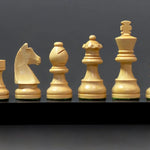
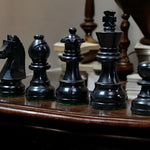
The defining characteristic of this series lies in its sheer physical weight and the "muscularity" of its proportions. Unlike the slender, almost spindly stems seen in some Victorian reproductions, these pieces feature thickened stems and significantly flared bases. This lowered centre of gravity provides a tactile reassurance that is rare in lighter sets. Each piece is typically triple-weighted with lead or steel, giving a standard 3.75-inch King a substantial feel that grounds the entire board. The Knight is particularly striking; its aggressive, forward-leaning posture and scowling features suggest a beast ready to leap, avoiding the fragility of more delicate patterns.
Why Serious Collectors Favour This Series
Serious collectors often find themselves torn between sets meant for a glass cabinet and those meant for the mahogany table. The Marshall Series Chess Pieces bridge this gap with a unique balance of tournament readiness and artisanal sophistication. It appeals to those who find the classic Staunton slightly too dainty for their hands. There's a particular satisfaction in the final move of a game when your fingers wrap around the broad base of the King. It feels definitive. It carries a gravitas that a hollow or plastic piece simply cannot replicate. This weight acts as a physical manifestation of the intellectual effort expended during the match.
Beyond the visual impact, the durability of these pieces makes them a practical investment for the long term. A common frustration with antique-style sets is the tendency for the Queen’s crenellations or the Bishop’s mitre to chip if handled too roughly. The Marshall design reinforces these vulnerable points with thicker carving, ensuring the set remains in pristine condition even after years of use. It is this marriage of brute strength and refined detail that continues to make the series a favourite among those who view chess as both a sport and an art form. Choosing a set like this is a nod to a time when the game was played with a certain rugged intensity, a feeling that stays with you every time you set the pieces on the board.
A Tribute to a Legend: The Historical Origins of the Marshall Design
To truly appreciate the aesthetic weight of The Marshall Series Chess Pieces, one must first understand the man who inspired their creation. Frank James Marshall, who held the title of United States Champion for an incredible 27 years between 1909 and 1936, was a player of singular ferocity. His tactical imagination and penchant for "swashbuckling" sacrifices demanded a set of tools that matched his intensity. While the mid-Victorian sets of the 1850s were undeniably beautiful, they often lacked the physical resilience required for the smoke-filled, high-stakes environments of early 20th-century New York chess rooms.
The transition from the delicate 1849 Staunton originals to the Marshall pattern represents a pivotal moment in the history of the game. This design was not born from a desire for mere decoration; it was a practical response to the rigours of professional play. By the time Marshall founded the Marshall Chess Club in 1915, his preference for a more robust, heavily weighted set had already begun to influence local manufacturers. This institution became more than just a meeting place; it acted as a cultural crucible where the requirements of the modern tournament player were forged into the wood and lead of the pieces we recognise today.
Frank Marshall: The Man Behind the Movement
Marshall’s rise to international prominence was cemented at the 1904 Cambridge Springs tournament, where he finished two full points ahead of world-class talents like Emanuel Lasker and David Janowski. His aggressive, "attacking" style of play was legendary, and he famously preferred pieces that felt substantial in the hand. This need for "sturdy" equipment led to a departure from the spindly necks seen in earlier Victorian sets. He wanted a King that felt like a monarch and a Knight that looked ready for a skirmish, leading to the broader bases and thicker stems that define this era of American chess history.
Evolution of the Staunton Pattern
When comparing The Marshall Series Chess Pieces to the earlier Morphy or Paulsen variants, the structural refinements are immediately apparent. The Rook, for instance, moved away from the taller, slimmer profile of the 1860s to a more "squat" and formidable silhouette. This change was largely to prevent the piece from toppling during rapid play, a common frustration in the blitz games Marshall loved. The Bishop also saw a transformation; the mitre was deepened and the overall height adjusted to provide a more harmonious progression across the ranks.
Perhaps the most distinctive hallmark of this series is the "widened collar" found on the King and Queen. This subtle widening of the decorative ring below the head serves a dual purpose. It provides a more ergonomic grip for the player while simultaneously lowering the centre of gravity. When combined with the triple-weighting techniques we employ at Official Staunton, the result is a set that offers a tactile satisfaction rarely found in modern mass-produced alternatives. These specific measurements, refined over decades in the clubs of Manhattan, eventually became the "gold standard" for American tournament play, balancing the elegance of the Staunton tradition with the durability required for a lifetime of use.
Another factor worth considering is the way these pieces interact with the board. The broader bases of the Marshall design require a slightly larger square, typically 55mm or 60mm, to allow the "breathing room" that grandmasters prefer. This spatial requirement reinforces the sense of grandeur associated with the set. It is a design that does not shy away from its presence, standing as a testament to an era when chess was as much about the physical theatre of the move as it was about the abstract calculation of the mind.
The Anatomy of Artistry: Hand-Carving and Material Excellence
The creation of a luxury chess set is less about mass production and more about the slow, deliberate work of the lathe and the chisel. At Official Staunton, we believe the true distinction of a set lies in its finish. While many modern sets are encased in thick, plastic-like lacquers that mask the wood's natural character, The Marshall Series Chess Pieces are finished with a meticulous hand-polishing process using organic waxes. This method preserves the tactile warmth of the timber, allowing the player to feel the actual grain rather than a cold, synthetic barrier. It is a time-consuming technique that requires the artisan to buff the wood repeatedly until it achieves a deep, soft lustre that will only improve as it ages.
The Knight: A Study in Fierce Elegance
The Marshall Knight is frequently cited by collectors as the pinnacle of the carver's art. Unlike the more passive, upright designs found in standard sets, this piece features an aggressive, downward-tilted head and bared teeth that mirror the fierce tactical style of the New York legend it honours. Every single Knight is carved from a solid block of wood by a master artisan who must possess the steady hand of a sculptor. Achieving perfect symmetry in the flowing mane and the sharp, alert ears across all four pieces in a set is a task that requires decades of experience. This "Knight Factor" is what separates a standard set from a true heirloom, as no machine can replicate the subtle, expressive curves of a hand-carved face.
Noble Woods: Ebony and Boxwood
We select only the finest specimens of Diospyros ebenum, or genuine Ebony, for the dark pieces. This wood is prized for its immense density and its natural resistance to the oils of the human hand, ensuring the pieces remain pristine over decades of use. For the lighter side, we employ Natural Boxwood, a timber with a grain so fine it allows for the most delicate detailing. In 2026, the ethical sourcing of these hardwoods is a non-negotiable standard for us; we ensure every log is harvested under strict sustainability certifications. Understanding the evolution of the Staunton chess set reveals why these specific materials became the gold standard for competitive play, as they offer the perfect balance of weight, beauty, and durability.
The Internal Architecture: Weighting and Felting
Stability is a technical necessity that we treat with the same reverence as pure aesthetics. Each piece in The Marshall Series Chess Pieces collection is triple-weighted by drilling into the base and inserting a precisely measured lead plug. This lowers the centre of gravity, ensuring that even a frantic time scramble in the final seconds of a game won't result in tipped pieces. We then finish the base with premium green Billiam cloth, a thick, high-grade felt that provides a soft landing and protects the surface of your board. When you place a piece during a match, you'll hear a deep, satisfying "thud" that speaks of internal substance. This sound is often the first thing a connoisseur notices, as it signals a level of quality that lighter, hollow pieces simply cannot match.
The weight and balance of these pieces aren't just for show; they change the way you interact with the game. There's a certain psychological confidence that comes from moving a piece that feels substantial in the hand. It encourages a more thoughtful, deliberate style of play, grounded in the physical reality of the materials. You'll find that the more you play with such a set, the more you appreciate the small details, like the way the light catches the bevelled edge of a Rook or the perfect curvature of the Queen's coronet.
Curating Your Collection: Pairing the Marshall Series with the Perfect Board
Selecting a board for the Marshall Series isn't merely a matter of finding a flat surface; it's about providing a stage that respects the physical gravity and architectural presence of these pieces. Because The Marshall Series Chess Pieces are designed with broader, more substantial bases than your standard club set, they require a board that offers enough "white space" to prevent the ranks from feeling congested. A board that is too cramped doesn't just hinder play; it actively diminishes the visual impact of the hand-carved knights and the regal stature of the King.
When you place these pieces in a home library or a dedicated study, you're creating a focal point for intellectual pursuit. The goal is to achieve a sense of "quiet authority" where the board and pieces exist in a symbiotic relationship. Choosing the right square size and timber combination ensures that the set remains a timeless centrepiece rather than a cluttered afterthought. It's about creating an environment where the game feels as significant as the history behind the design itself.
Sizing Guidelines for Professional Play
To achieve the perfect balance, connoisseurs often look to the "75% rule" as a definitive guide. This principle suggests that the diameter of the King’s base should occupy roughly 75% of the square's width. For a 3.75-inch or 4-inch King in this series, which typically features a base diameter of 42mm to 44mm, a square size of 55mm to 60mm is essential. If you attempt to squeeze these pieces onto a 50mm square, the board will look overcrowded, and the fluid movement of pieces during a complex middle-game becomes physically cumbersome.
Professional tournament standards in the UK often lean towards the 55mm square for 3.75-inch sets, but for the 4-inch Marshall King, a 60mm square provides a more luxurious, expansive feel. This extra breathing room allows the intricate details of the carving to stand out. When the squares are too small, the powerful silhouette of the Marshall knight is lost against the backdrop of the surrounding pieces, stripping the set of its legendary New York character.
Aesthetic Harmony: Wood Tones and Finishes
The choice of timber for your board can fundamentally alter the mood of the display. For those who own the Ebony version of The Marshall Series Chess Pieces, an Ebony and Maple board creates a striking, monochromatic aesthetic that feels both modern and deeply traditional. The deep black of the pieces against the crisp, pale squares offers a high-contrast look that is favoured by many serious players for its clarity during long hours of analysis. It's a combination that speaks to the Victorian origins of the Staunton design while fitting perfectly into a contemporary interior.
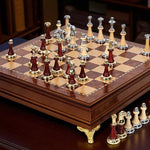
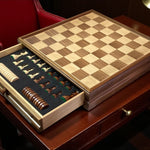
If you prefer a softer, more historic atmosphere, pairing these pieces with a warm Walnut or Mahogany board is a superb alternative. The earthy tones of Walnut complement the Boxwood pieces beautifully, creating a rich, autumnal palette that feels at home amongst leather-bound books and soft lamp lighting. Another factor worth considering is the finish of the board. While high-gloss boards look spectacular in photographs, a matt or satin finish is often the superior choice for actual play. Satin finishes reduce the glare from overhead lights, allowing you to focus on the wood grain and the position of the pieces without distraction.
Finding the right foundation is the final step in honouring this legendary design. You can explore our exquisite collection of luxury chess boards to find the perfect match for your Marshall set.
Ultimately, the pairing of board and pieces is a personal reflection of your appreciation for the game's heritage. Whether you opt for the stark brilliance of Ebony or the inviting warmth of Walnut, the key is to ensure the dimensions allow the pieces to breathe. When the proportions are correct, the set transcends its function as a game and becomes a genuine work of art, ready for decades of thoughtful play and quiet admiration in your home.
The Official Staunton Standard: Why Our Marshall Series is a Modern Heirloom
The commitment we hold toward historical accuracy isn't merely a design choice; it's a foundational principle that has guided Official Staunton since our inception in 1993. When you hold one of The Marshall Series Chess Pieces, you're interacting with a design that refuses to compromise on the architectural integrity of the 1849 original. We don't view these sets as fleeting consumer goods. Instead, we treat them as functional archives of a golden age in chess. Our restoration-friendly philosophy ensures that every piece is finished with traditional techniques, allowing a skilled craftsman to refurbish them decades from now if needed. This approach contrasts sharply with the disposable nature of modern manufacturing, where finishes are often synthetic and impossible to repair once damaged.
Before any set leaves our care, it undergoes a final, exhaustive inspection within our Whitchurch workshop. This isn't a cursory glance; it's a deliberate process where we check for weight consistency, balance, and the seamless fit of the green baize bases. We look for the subtle nuances that a machine would miss, such as the symmetrical carving of the Knights’ manes or the precise depth of the Rook’s crenellations. By the time a set reaches your study, it has been handled and verified by experts who understand that a chess piece is a tactile tool for the mind. We invite you to step beyond the role of a consumer and become a custodian of this legacy, preserving a standard of excellence that has defined the game for nearly two centuries.
Hand-Finished in the United Kingdom
The role of our Shropshire-based experts is vital in maintaining the reputation we've built over the last 30 years. In our Whitchurch facility, the final quality control phase involves a hands-on assessment of every individual piece. We ensure the natural grain of the boxwood and ebony is celebrated rather than obscured by heavy lacquers. Our artisans use fine-grade abrasives and traditional polishing waxes to bring out a soft, natural lustre that feels warm to the touch. This dedication to the "feel" of the wood is a hallmark of our 1993 founding principles, ensuring that the organic beauty of the material remains the protagonist of the design. You'll notice that the grain patterns are unique to your specific set, making it a one-of-a-kind assembly of natural history.
Investment and Longevity
Choosing a handcrafted wooden set is a decision that yields rewards far beyond the initial purchase. While mass-produced plastic or resin alternatives may serve a temporary purpose, they lack the intrinsic value and durability of The Marshall Series Chess Pieces. A high-quality wooden set often appreciates in sentimental and market value, especially as the availability of premium timbers like Grade-A Ebony becomes more restricted. There is also the fascinating "patina" effect to consider. Over decades of use, the boxwood will naturally deepen into a rich, honey-toned amber, while the darker pieces develop a soft glow from the oils of the players' hands. This aging process doesn't signal wear; it records the history of the games played with it.
- Material Integrity: We use triple-weighting techniques to ensure a King weight of approximately 75g to 90g, providing a satisfying "thud" on the board.
- Heritage Sourcing: Our woods are selected for density and grain stability to prevent cracking in varying climates.
- Generational Value: These sets are designed to be passed down, serving as a physical bridge between the mentors of today and the grandmasters of tomorrow.
The Marshall Series serves as a bridge between the Victorian origins of the Staunton style and the contemporary player who demands professional-grade equipment. It's a quiet satisfaction to know that the set you use for a casual Sunday game is built to the same exacting standards as those used in the most prestigious New York clubs of the 1900s. Owning such a set is a reflection of your respect for the game’s history and an investment in its future. When you sit down to play, you aren't just moving wood across a board; you're participating in a continuous lineage of intellectual pursuit that Official Staunton is proud to protect.
Securing a Piece of Grandmaster History
Owning a set of these pieces isn't just about utility; it's about holding a tangible connection to the 1904 Cambridge Springs tournament and the aggressive brilliance of Frank Marshall himself. Since 1993, Official Staunton has remained steadfast in our commitment to these exacting historical standards, ensuring every knight's profile and every rook's battlement reflects the original aesthetic that defined an era of American chess. When you run your fingers over the polished boxwood or feel the substantial heft of the triple-weighted bases, you're experiencing the work of master artisans who still use traditional hand-carving techniques to preserve this legacy.
Selecting The Marshall Series Chess Pieces means you're investing in a functional work of art that bridges the gap between the Victorian origins of the Staunton design and the needs of the modern connoisseur. It's a choice that respects the game's past while preparing for decades of future play. Because we believe such craftsmanship deserves a seamless journey to your study, we provide complimentary UK shipping on all our luxury series. We invite you to explore the exquisite Marshall Series at Official Staunton and discover a set that will truly stand the test of time.
Frequently Asked Questions
What is the standard King height for the Marshall Series Chess Pieces?
The standard King height for the Marshall Series Chess Pieces is 3.75 inches, which equates to approximately 95 millimetres. This specific height is widely regarded by enthusiasts as the ideal balance between presence and playability on a standard club board. Each King features a base diameter of 1.7 inches, providing a sturdy foundation that feels substantial during a high-stakes match. It's a size that honours the traditional proportions established in the mid-19th century and remains the preferred choice for serious study.
Are the Marshall Series pieces suitable for competitive tournament play?
Yes, these pieces fully comply with the standards set by the International Chess Federation (FIDE) and the English Chess Federation for competitive use. The design maintains the requisite Staunton silhouette while offering the durability needed for the rigours of tournament clocks. Since their introduction, many players have chosen this series for its clear piece recognition, which prevents any ambiguity during time-scramble situations. They're a staple in clubs from London to New York for this reason.
What is the difference between double-weighted and triple-weighted chess pieces?
Triple-weighted pieces typically weigh upwards of 1,500 grams for a full set, whereas double-weighted sets usually sit around the 1,000-gram mark. We achieve this density by embedding lead or steel slugs deep within the base of each piece before sealing it with high-quality billiard cloth. The extra weight in a triple-weighted set provides a more luxurious, planted feel on the board. This prevents pieces from tipping over if they're accidentally brushed during an intense sequence of moves.
How do I clean and maintain my Ebony and Boxwood chessmen?
You should clean your chessmen using a soft, dry microfibre cloth to remove dust and skin oils after every few games. For deeper preservation, we recommend applying a tiny amount of Renaissance Wax or a high-grade beeswax every 12 months to protect the grain. Don't use water or chemical sprays, as these can cause the organic wood fibres to swell or crack. Maintaining the lustre of genuine Ebony requires patience, but it ensures your investment remains a family heirloom for decades.
Why is the Knight in the Marshall Series so different from other sets?
The Marshall Series Knight is modelled after the specific 1940s design favoured by US Champion Frank Marshall, featuring a distinctive, aggressive muzzle and a swept-back mane. Unlike the more upright Victorian Knights, this version captures a sense of dynamic movement and fierce character that reflects the American attacking style of play. Our artisans spend over two hours hand-carving each individual Knight to ensure these fierce facial expressions are consistent across the entire production run.
Does Official Staunton provide replacement pieces if one is lost?
Official Staunton maintains a dedicated archive of spare pieces to ensure your set remains complete even if a Pawn or Bishop goes missing. We understand that a lost piece shouldn't render an entire £300 investment obsolete, so we offer a bespoke matching service for our customers. Simply provide your original order details and we'll source a replacement that matches the specific grain and weight of your existing Marshall Series Chess Pieces. This service is part of our commitment to your lifelong enjoyment of the game.
Which board size is best for a 3.75-inch Marshall Series set?
A board with 55-millimetre squares is the perfect companion for a set with a 1.7-inch King base. This follows the professional guideline where the King's base should occupy approximately 75 to 80 per cent of the square's width. If you prefer a slightly more spacious aesthetic, a 60-millimetre square board also works beautifully. Choosing the correct proportions ensures the board doesn't look cluttered, allowing the intricate carvings of the pieces to breathe and be appreciated from every angle.
Are these pieces carved by hand or by machine?
Every piece in this collection is painstakingly carved by hand by master artisans who have spent decades perfecting their craft. While lathes are used to create the initial round profiles of the Pawns and Rooks, the intricate details of the Knights and the crenulations of the Queens are finished with handheld chisels. This human touch means that no two sets are identical, giving each one a unique soul that a CNC machine simply cannot replicate. It's this dedication to craftsmanship that defines our heritage.
Leave a comment