






The Art of the Hand Carved Chess Set: A Connoisseur’s Guide to Heritage and Craft
A chess set is often treated as a mere utility for play, yet for the true collector, it represents a profound intersection of Victorian history and artisanal skill. You understand that the weight of a piece and the precise curve of a Knight's neck in a hand carved chess set are not just aesthetic choices; they're essential to the dignity of the game. It's a common frustration to seek a legacy piece only to be met with machine-turned components that lack the soul of traditional craftsmanship. This discrepancy often leaves enthusiasts questioning whether a set will truly stand the test of time or simply fade as another mass-produced item.
In this guide, you'll discover the nuances of selecting a hand carved chess set that serves as both a formidable tool for strategy and a timeless centrepiece. We shall examine the specific densities of woods like Grade A ebony and the meticulous standards required to meet the patterns first registered in September 1849. Another factor we'll explore is the artisan's touch, where a single pair of Knights can require over 15 hours of focused carving to achieve symmetry. By understanding these historical benchmarks, you can invest with the confidence that your chosen set possesses the authentic pedigree and tactile perfection that Official Staunton has championed for decades.
Key Takeaways
- Trace the storied evolution of the 1849 Staunton standard, discovering how functional game pieces were elevated into symbols of intellectual prestige and Victorian heritage.
- Peer into the artisan’s workshop to see how a hand carved chess set is brought to life through the patient application of traditional chisels and polishing cloths.
- Explore the hierarchy of noble materials to understand why the density and natural weight of ebony and boxwood remain the gold standard for serious collectors.
- Develop a connoisseur’s eye for quality, focusing on the refined proportions of the Golden Ratio and the tactile necessity of a premium billiard-cloth base.
- Learn the essential practices for preserving your investment, ensuring the wood grain and finish remain flawless against the subtle environmental challenges of the home.
The Allure of the Hand Carved Chess Set: A Masterpiece in Miniature
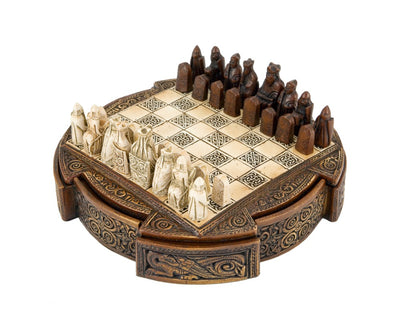
A chess board is far more than a grid for tactical warfare; it is a stage for a rare intersection where mathematical rigidity meets the fluid grace of the sculptor's chisel. When you hold a piece from a premium hand carved chess set, you aren't just gripping a gaming tool. You're feeling the weight of a tradition that has survived centuries of industrial upheaval. These sets represent a fusion of geometric precision and raw artistic expression, where every millimetre of wood is considered and refined by a master craftsman's hand.
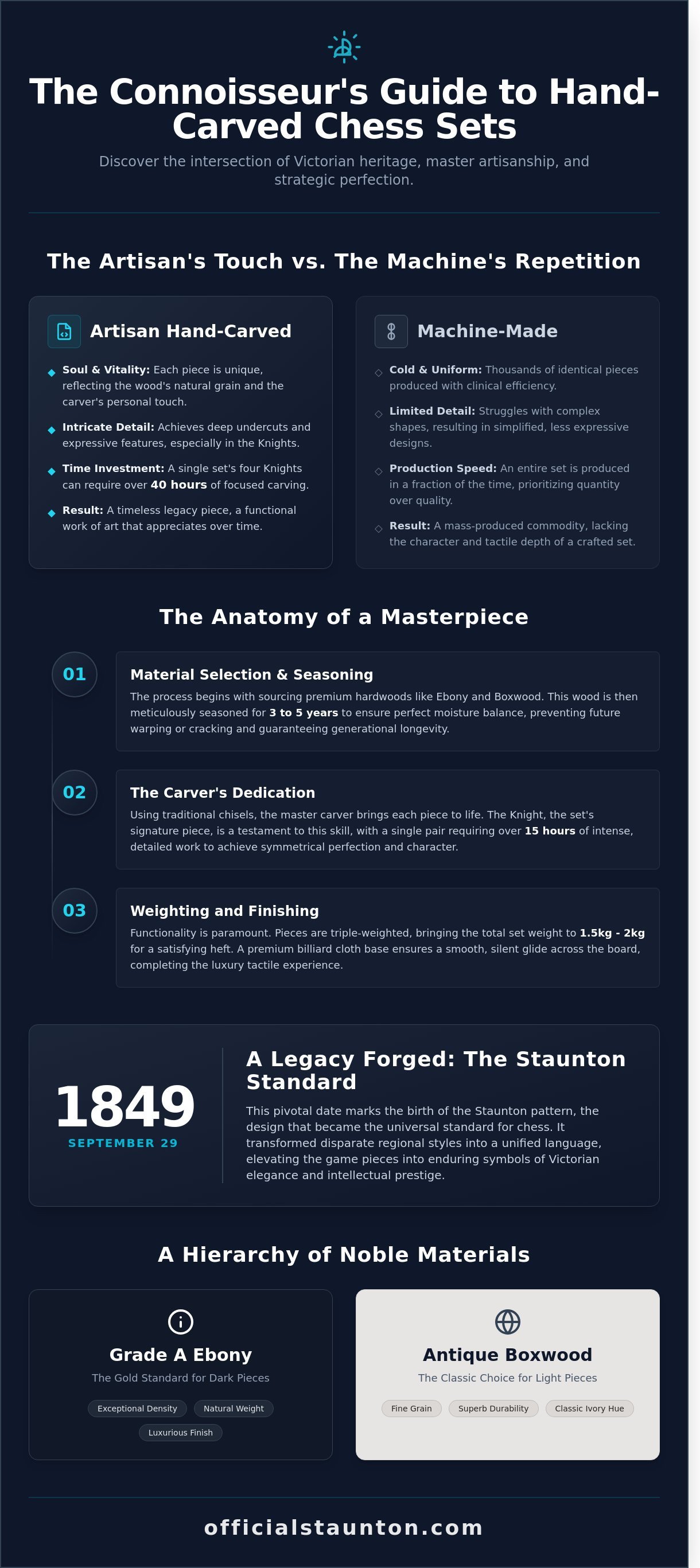
The history of these objects took a definitive turn on 29th September 1849, when the design we now recognise as the international standard was first released to the public. Before this pivotal moment, players often struggled with disparate, unstable designs that varied wildly between regions, making international play a logistical nightmare. The introduction of the Staunton chess set provided a universal language for the game. This design didn't just standardise play; it elevated the pieces into symbols of Victorian elegance and intellectual prestige, a status they still hold in the modern British home.
There's a specific "soul" within hand-carved wood that machine-turning simply cannot replicate. While a computer-controlled lathe can produce a thousand identical pawns with clinical efficiency, it lacks the ability to respond to the natural variations in the grain. A master carver listens to the wood, adjusting their pressure and angle to accommodate the unique density of a piece of Ebony or Boxwood. This human interaction creates a subtle vitality, a sense that the piece is a living object rather than a mass-produced commodity. In a world of digital screens and plastic disposability, a hand-carved set serves as a sophisticated centrepiece that anchors a room with its quiet, historical authority.
The Distinction Between Hand-Crafted and Mass-Produced
You might notice that machine-lathed pieces often feel "cold" or overly symmetrical. They lack the minute, purposeful irregularities that signal a human touch. Automated carving faces significant limitations when attempting deep undercuts or the expressive facial features required for a truly regal Knight. These "imperfections" are not flaws; they are the signatures of the artisan. A master carver might spend upwards of 40 hours on the four Knights of a single set, ensuring each has a distinct personality while maintaining a cohesive aesthetic. This level of dedication creates a tactile depth that no automated process can ever hope to mirror.
The Philosophy of Functional Art
Every piece in a hand carved chess set must exist as an individual sculpture while remaining perfectly functional on the board. This balance is a delicate one. A King must possess a commanding presence and intricate detail, yet it must also be ergonomically comfortable for a player to lift and move during a tense endgame. Most high-quality sets are triple-weighted, often reaching a total weight of 1.5kg to 2kg, giving them a satisfying "thud" when placed on the board. This physical heft, combined with the soft glide of a billiard cloth base, invites a slower, more contemplative style of play. It encourages you to linger over your move, respecting the artistry of the pieces as much as the logic of the game. It's a reminder that chess is as much a pursuit of beauty as it is a battle of wits, turning every match into a shared appreciation of heritage and craft.
The Anatomy of Artistry: Understanding the Artisan’s Process
The creation of a hand carved chess set begins long before a blade touches wood. It starts with the selection of premium hardwoods, typically Boxwood for the light pieces and Ebony or Rosewood for the dark side. These timbers must be seasoned for a minimum of three to five years to ensure the moisture content is perfectly balanced. If the wood is too green, it will inevitably warp or crack as the internal stresses are released during carving. An artisan must also pay meticulous attention to grain orientation. By aligning the cut with the natural growth patterns of the tree, the carver ensures the finished piece possesses the structural integrity required to last for generations.
The tools of the trade are as traditional as the designs themselves. While the bases and stems are shaped on a precision lathe, the intricate details are born from a series of fine chisels, gravers, and files. To achieve that substantial, authoritative feel, a cavity is bored into the base of each piece to accommodate lead or steel weights. A high-quality 4.0-inch King in a triple-weighted set often tips the scales at approximately 85 grams, providing a gravitational stability that makes every move feel deliberate and significant. This internal weighting is then sealed with a thick layer of billiard cloth or leather, protecting the board from scratches.
The Knight: A Sculptural Litmus Test
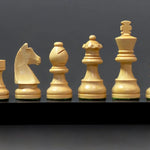
The Knight stands as the definitive measure of a carver's skill because it's the only piece that cannot be produced solely on a lathe. It requires hours of painstaking manual labour to sculpt the flowing mane, the flared nostrils, and the expressive, alert eyes that characterise a true master-grade piece. You can often distinguish a premium set by the symmetry between the four Knights; in a commercial set, they may look like cousins, but in a professional hand carved chess set, they appear as identical quadruplets. Historical examples, such as the 19th-century Indian chess set housed at the Met, demonstrate how this sculptural complexity has been the hallmark of luxury for centuries.
From Raw Block to Polished Piece
Once the carving is complete, the pieces undergo a rigorous finishing process. Rather than using modern spray-on lacquers, the finest sets employ a traditional French polish. This involves applying multiple layers of shellac and oil with a soft cloth, a technique that requires patience and a gentle touch to highlight the depth of the natural wood grain. Every set produced by Official Staunton follows this exacting standard, ensuring that each of the thirty-two pieces shares a harmonious lustre and weight. A final quality check involves inspecting the uniformity of the crowns and the sharpness of the mitre on the Bishop, ensuring the set meets the standards expected by the serious collector. If you're looking to start your own collection, you might consider exploring our luxury wooden chess sets to see these techniques in practice.
The journey from a raw block of timber to a finished chessman is one of quiet discipline and historical reverence. It's a process that rejects the haste of modern manufacturing in favour of a slower, more deliberate pace. When you hold a piece from a hand carved chess set, you aren't just holding a tool for a game; you're holding the result of decades of inherited knowledge and hours of individual focus. This dedication to the craft ensures that the set you choose today will remain a centerpiece of your study for decades to come, eventually becoming a cherished heirloom that tells its own story of heritage and intellect.
Noble Materials: Selecting the Finest Hardwoods for Longevity
The choice of timber defines the soul of a hand carved chess set. It isn't merely about aesthetics; it is about the tactile weight, the resistance to the carver’s chisel, and the way the wood ages over a century of play. Master artisans generally look for timbers with a high Janka hardness rating. Ebony, for instance, sits at the pinnacle with a rating often exceeding 3,000 lbf, making it one of the densest and most challenging materials to work with. This density ensures that every knight’s mane and every rook’s battlement remains crisp and sharp for generations, resisting the softening of detail that plagues lesser woods.
The chemical composition of these woods plays a vital role in their longevity. High natural oil content in species like Ebony and certain Rosewoods acts as a natural preservative, protecting the internal fibres from the humidity fluctuations common in British homes. This density also creates the legendary "thud" when a piece is moved across the board. When a triple-weighted ebony king is placed firmly on a solid mahogany board, the sound is deep and resonant. It is a sensory experience that signals quality, a far cry from the hollow click of mass-produced alternatives. You might wonder why a specific species of timber commands a price tag of several hundred pounds; the answer lies in the scarcity of the grain and the decades it takes for these slow-growing trees to reach maturity.
Ethical stewardship is a cornerstone of modern craftsmanship. Since the 2017 CITES regulations tightened the trade of Dalbergia species, there has been a necessary shift towards more transparent, sustainable sourcing. We view ourselves as custodians of these rare materials. Preserving these timbers through responsible forestry ensures that future generations can still experience the tactile majesty of a genuine hardwood masterpiece. It is a commitment to the environment that mirrors our commitment to the 1849 Staunton legacy.
The Dark Elegance of Ebony and Rosewood
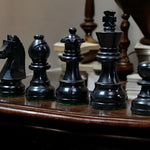
Ebony is frequently referred to as the "black gold" of the chess world. With a density of approximately 1,200 kg/m³, it is one of the few woods that will actually sink in water. This natural heft provides an inherent stability that requires very little lead weighting to feel substantial in the hand. Rosewood and its more vibrant cousin, Bud Rosewood, offer a different allure. These timbers are prized for their rich, reddish-brown hues and the intricate, swirling grain patterns that look almost liquid under a polished finish. Over decades of careful use, these dark woods develop a unique patina, a soft lustre that reflects the history of the games played with them.
Boxwood: The Ideal Canvas for Detail
Boxwood has remained the traditional "light side" choice since the mid-19th century, specifically chosen for its remarkable structural integrity. The grain of Buxus sempervirens is so tight and uniform that it allows for incredibly fine, splinter-free carving, which is essential for the intricate features of a hand carved chess set. An artisan can carve the minute teeth of a knight or the delicate crenellations of a rook without fear of the wood shearing. When matched with a darker hardwood, boxwood provides a perfect visual balance. Its density, while slightly lower than ebony at around 950 kg/m³, is close enough to ensure that both sides of the board feel consistent in weight and momentum during play.
Selecting a set crafted from these noble materials is an investment in functional art. The marriage of ebony and boxwood isn't just a stylistic choice; it's a technical requirement for a set intended to last a lifetime. When you hold a piece carved from these hardwoods, you feel the weight of history and the dedication of the craftsman who shaped it. It is this connection to the material world that makes the game so enduringly tactile and profound.
The Connoisseur’s Criteria: Evaluating Quality and Heritage
Identifying a truly superior hand carved chess set requires more than a passing glance at its silhouette; it demands an appreciation for the mathematical precision established in the autumn of 1849. The original Staunton design, famously registered by Nathaniel Cook, was far more than a simple aesthetic update. It was a revolution in functional geometry that brought order to the chaotic variety of sets used in the early 19th century. The proportions of these pieces often mirror the Golden Ratio, ensuring that the height of the King relates harmoniously to the width of its base and the dimensions of the squares on the board.
You might wonder why such minute details matter during a casual match. The answer lies in the psychological weight of the game. A King that stands at the traditional 4-inch height provides a focal point for the entire board, commanding space without crowding the surrounding pieces. This balance is achieved through a meticulous adherence to historical specifications that Official Staunton has preserved for decades. When a set follows these classic lines, it feels familiar to the hand of a grandmaster and the eye of a collector alike.
Weighting and Balance: The Feel of the Game
A player's physical connection to the strategy is felt through the fingertips. While some exotic hardwoods like Ebony or African Ironwood possess a natural density, most premium pieces require internal lead weighting to achieve that satisfying thud on a wooden surface. For a 4-inch King, a weight of approximately 75 to 95 grams is widely considered the sweet spot for stability. This deliberate low centre of gravity ensures that even during a frantic blitz game, a piece won't tip over if it's brushed by a sleeve or moved in haste. It provides a sense of permanence that lighter, hollow alternatives cannot hope to replicate.
Another factor worth considering is the material used for the base. We insist on heavy-duty billiard cloth, typically in a deep heritage green or traditional burgundy. This thick, woven wool felt serves a dual purpose; it allows the piece to glide effortlessly across the board while protecting the polished surface from unsightly scratches. You'll find that lesser sets often use thin, synthetic felt that wears away within 12 months, eventually leaving the wood vulnerable to the friction of play.
Authenticity and the 1849 Staunton Legacy
Sticking to the 1849 Staunton pattern is vital for any serious player. The specific design cues, such as the distinct crenellations on the Rook and the elegant, hand-carved mane of the Knight, define the Official Staunton signature. These are not merely toys; they're historical reproductions that honour the Victorian era's dedication to artisan craftsmanship. A genuine hand carved chess set from this lineage should always include two additional Queens for pawn promotion. This practice became standard to avoid the indignity of using an upside-down Rook, a common sight in the mid-1800s before the Staunton standard was adopted globally.
Every investment-grade set is accompanied by historical documentation or a certificate of authenticity. This paper trail links your set to the master carvers who may spend up to 45 hours perfecting the four Knights in a single collection. When you hold a piece that feels perfectly balanced and looks historically accurate, you're engaging with a 175-year-old legacy of intellectual pursuit. To ensure your collection meets these exacting standards, you can browse our authenticated Staunton reproductions and experience the difference that heritage makes.
The choice of a chess set is ultimately a reflection of how one views the game itself. By prioritising the weight, the felt, and the historical accuracy of the 1849 design, a collector ensures that their set remains a functional masterpiece for generations. It's these small, often overlooked details that transform a simple game into a profound experience of artistry and tradition.
Preserving a Legacy: Integrating Luxury Chess into the Modern Home
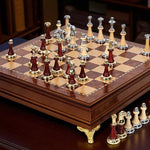
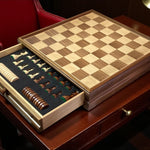
Owning a hand carved chess set is a responsibility that extends far beyond the final checkmate of an evening. These objects are crafted from organic materials that continue to breathe and react to their surroundings long after they leave the artisan's workshop. When you select a board to accompany your pieces, the relationship between the two must be one of absolute harmony. A King with a base diameter of 1.75 inches requires the breathing room of a 55mm square to avoid a cluttered appearance. Choosing a board in a contrasting but complementary timber, such as a dark Macassar Ebony board for Boxwood pieces, creates a visual tension that highlights the intricate carving of each individual figure.
Environmental factors play a silent but significant role in the longevity of your investment. Wood is a hygroscopic material, meaning it absorbs and releases moisture based on the atmosphere. In the United Kingdom, where central heating can strip the air of its natural humidity during winter, it's vital to keep your set away from direct heat sources like radiators or open fires. Maintaining a stable relative humidity between 40% and 60% prevents the timber from contracting too quickly, which is the primary cause of hairline fractures in the base of the pieces. Equally, the ultraviolet rays from direct sunlight can bleach the deep, oily finish of Rosewood or Padauk over a period of just twelve months.
The ritual of maintenance is a meditative process that connects the owner to the craftsman. You don't need harsh chemicals or abrasive polishes to keep the lustre alive. A soft microfibre cloth is usually sufficient for weekly dusting, ensuring that dust doesn't settle into the fine details of the Knight's mane. Every six months, applying a pea-sized amount of high-quality Renaissance Wax, a microcrystalline polish used by the British Museum, will provide a protective barrier against skin oils. Buffing the pieces gently by hand allows you to inspect the grain and appreciate the subtle variations that prove each piece was shaped by a human hand rather than a machine.
Beyond its function as a game, a luxury set serves as a bridge between generations. It's an heirloom that carries the stories of every match played upon its surface. When you pass a set down to a child or grandchild, you aren't just giving them a collection of wooden figures; you're gifting them a legacy of patience, strategy, and appreciation for fine art. It becomes a permanent fixture of the family home, standing as a testament to a time when objects were built to last for centuries rather than seasons.
Displaying Your Set as a Centrepiece
Placing a hand carved chess set in a prominent position, such as a dedicated library table or a focal point in a drawing room, transforms the atmosphere of the entire space. There's a profound psychological effect to having a game "at the ready." It suggests a home where intellectual pursuit and slow, deliberate thought are valued over the frenetic pace of digital life. A set left mid-game acts as an open invitation for a guest to study the position, sparking conversations that move beyond the superficial. It reflects an owner who appreciates the intersection of Victorian design principles and modern aesthetic refinement.
The Official Staunton Commitment to Craft
Our work at Official Staunton is rooted in the belief that the 1849 Staunton design is the pinnacle of functional sculpture. We reject the soulless output of modern factories, choosing instead to collaborate with master carvers in the Amritsar region who have spent decades perfecting their trade. This dedication allows us to offer sets that are historically accurate, from the specific weight of the lead ballast to the precise curvature of the Bishop's mitre. We take our role as custodians seriously, often providing restoration advice for antique sets to ensure the carver's original vision survives another century. Whether you're exploring the aggressive, flared manes of our Morphy series or the understated elegance of the Fischer Spassky sets, you're engaging with a tradition that we're proud to uphold.
Choosing a set is the beginning of a lifelong journey. As the wood patinas and the edges soften with use, the set will develop a character that is entirely unique to your home. It's an investment in beauty that yields its greatest rewards through the quiet moments of reflection and the spirited battles across the squares that define the timeless allure of the game.
Securing a Legacy for Future Generations
Selecting a hand carved chess set is a profound gesture that transcends the simple acquisition of a game. It represents a commitment to preserving a standard of excellence that has defined the intellectual landscape since the original 1849 design. You've explored how the marriage of ethically sourced hardwoods and meticulous weighting creates an object that feels substantial in the hand and looks magnificent on the mantelpiece. At Official Staunton, we've dedicated ourselves to this pursuit since 1993; we ensure that every knight's mane and every bishop's mitre reflects the quiet authority of the artisan's touch. Our deep expertise even extends to specialist restoration services, allowing us to safeguard the history of heirloom sets for families across the United Kingdom.
You might find that the true value of such a set isn't found in its price, but in the slow, rhythmic pace of a game played over a board of polished wood. It's a tactile connection to the past that remains stubbornly relevant in our digital age. Whether you're a seasoned collector or a novice looking for your first serious investment, the right choice will serve as a silent witness to countless hours of strategy and reflection. We invite you to explore our exquisite collection of hand-carved chess sets at Official Staunton and discover a masterpiece that resonates with your own sense of heritage. It's an honour to help you find a piece of history that you'll be proud to pass down through the years.
Frequently Asked Questions
How can you tell if a chess set is truly hand-carved?
You can identify a genuine hand carved chess set by examining the subtle asymmetries that define artisanal work. Unlike the sterile, repetitive perfection of machine-milled pieces, hand-crafted sets show minute variations in the depth of the Knight's eye sockets or the curvature of its mane. If you compare two Knights side by side and find they're identical in every microscopic detail, it's likely the set was produced by a computer-controlled lathe rather than a master carver's chisel.
Why is the Knight usually the most detailed piece in a hand-carved set?
The Knight represents the only non-symmetrical piece in the Staunton design, making it a sculptural challenge that cannot be completed on a standard lathe. While the other pieces are turned, the Knight requires a specialist artisan to spend up to three hours carving the lifelike features of the horse. This specific focus on the Knight is why collectors often judge the entire quality of a hand carved chess set by the expression and detail found in this single piece.
What wood is best for a luxury hand-carved chess set?
Genuine Gaboon Ebony and Boxwood are the definitive choices for those seeking the pinnacle of luxury and historical accuracy. These timbers possess a high density of approximately 1,200 kg/m3, which allows the carver to execute incredibly fine details without the grain splintering. Official Staunton prefers these materials because they develop a deep, natural patina over decades of use, a quality that cheaper stained woods simply cannot replicate.
Does the weight of the pieces affect the playing experience?
Weighting is essential for providing a sense of gravitas and stability during a match. A triple-weighted King, which typically weighs around 80 grams, offers a lower centre of gravity that prevents the piece from toppling if it's brushed during a tense moment. This physical heft creates a satisfying thud against the wooden board, which many serious players find enhances the psychological rhythm of their game.
How should I clean and maintain my hand-carved wooden chess pieces?
You should maintain your pieces by lightly buffing them with a soft microfibre cloth and a small amount of high-quality beeswax every six months. It's vital to keep the set in a stable environment with a relative humidity between 45% and 55% to prevent the natural timber from expanding or cracking. You'll want to avoid modern aerosol polishes, as the chemicals can degrade the delicate felt bases and strip the wood's natural oils.
Is a hand-carved chess set considered a good financial investment?
High-quality sets often appreciate in value, especially those crafted from rare timbers that are becoming increasingly difficult to source. Historical auction data indicates that well-preserved artisan sets from the mid-20th century have seen value increases of roughly 20% to 30% over the last decade. When you invest in an Official Staunton set, you're purchasing a piece of functional art that carries the weight of heritage and potential future scarcity.
What size board do I need for a hand-carved set with a 4-inch King?
A King with a 4-inch height and a 1.75-inch base diameter requires a board with squares measuring exactly 55mm to 60mm. This sizing follows the professional standard where the base of the King should occupy about 75% of the square's total area. Choosing a board that's too small will make the pieces feel cramped, while a board that's too large can make the set look sparse and diminish the visual impact of the carving.
Why are some hand-carved sets significantly more expensive than others?
The price reflects the total hours of labour and the pedigree of the master carver involved in the production. A set priced at £200 might be carved by a team of apprentices, whereas a £1,500 masterpiece is often the work of a single artisan who has spent 40 hours perfecting every mitre and crenellation. The rarity of the wood, such as Grade-A Ebony, also contributes to the cost, as only 10% of harvested timber might meet the strict aesthetic standards required for a premium set.
The journey of selecting a hand-carved chess set is as much about personal connection as it is about technical specifications. When you hold a piece that has been shaped by a human hand, you're interacting with a tradition that stretches back to the mid-19th century. Whether you're a competitive player or a dedicated collector, these sets offer a tactile link to the history of the game that no machine can ever truly replicate. Taking the time to understand the nuances of timber, weight, and carving style ensures that your chosen set will remain a source of pride and intellectual inspiration for many years to come.
Leave a comment